


| Page |  |
 |
|
 |
 |
Calculation of Moving Averages
The averages were calculated for every four quarters because the seasonal
variation (the pattern) repeats in four quarters. The average for quarters 1 to 4 is
calculated first, by adding the values together and dividing by 4. Then you move
on one quarter and average quarters 2 to 5. The process is repeated by averaging
quarters 3 to 6 and then 4 to 7. The calculations are shown below. The averages
are called moving averages because you move on one quarter each time.
The first moving average is found by calculating the mean for the four quarters
of 2000 as follows:
670 + 800 + 460 + 730
=
2660
=
665
4
4
The second moving average is found by moving along one quarter and
averaging the last three quarters in 2000 with the first quarter in 2001 (quarters
2,3,4 and 5).
800 + 460 + 730 + 640
=
2630
=
657.5
4
4
This process is repeated. Because these averages are calculated for four
consecutive quarters each time, they are called 4-point moving averages.
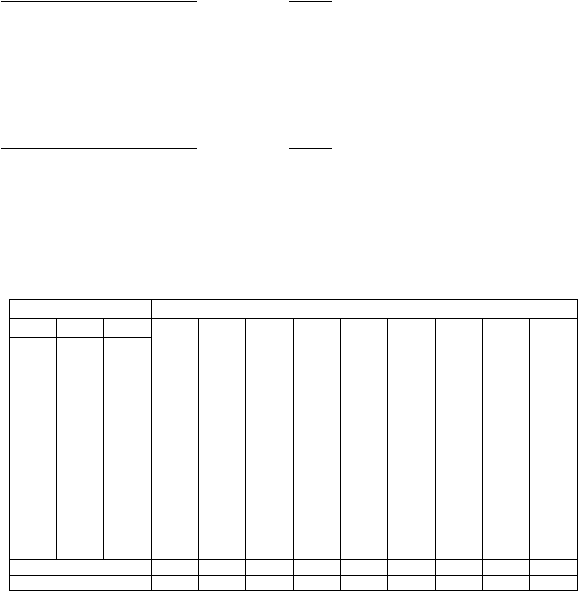
The calculations are best done inside a table as shown below:
Electricity used
Moving average calculations
Year
Quarter
Units
2000
1
670
670
2
800
800
800
3
460
460
460
460
4
730
730
730
730
730
2001
1
640
640
640
640
640
2
840
840
840
840
840
3
410
410
410
410
410
4
740
740
740
740
740
2002
1
660
660
660
660
660
2
870
870
870
870
3
480
480
480
4
750
750
4-point moving sum
2660
2630
2670
2620
2630
2650
2680
2750
2760
4-point moving average
665
657.5
667.5
655
657.5
662.5
670
687.5
690
The number of points chosen for the moving average depends on the pattern of
the data. You could have data for each day of the week over several weeks, and
so use a 7-point moving average, or maybe monthly data for several years, in
which case you may use a 12-point average. In an exam question you will
probably be told how many points to use in the calculation.
|
 |
|